When Should You Repair or Replace Your AC? A Complete Guide
Should you repair your AC or replace it? Learn how AC age, repair costs, frequent breakdowns, energy consumption, cooling performance, and major component failures can help you make the right decision.
MendAI Team
Author
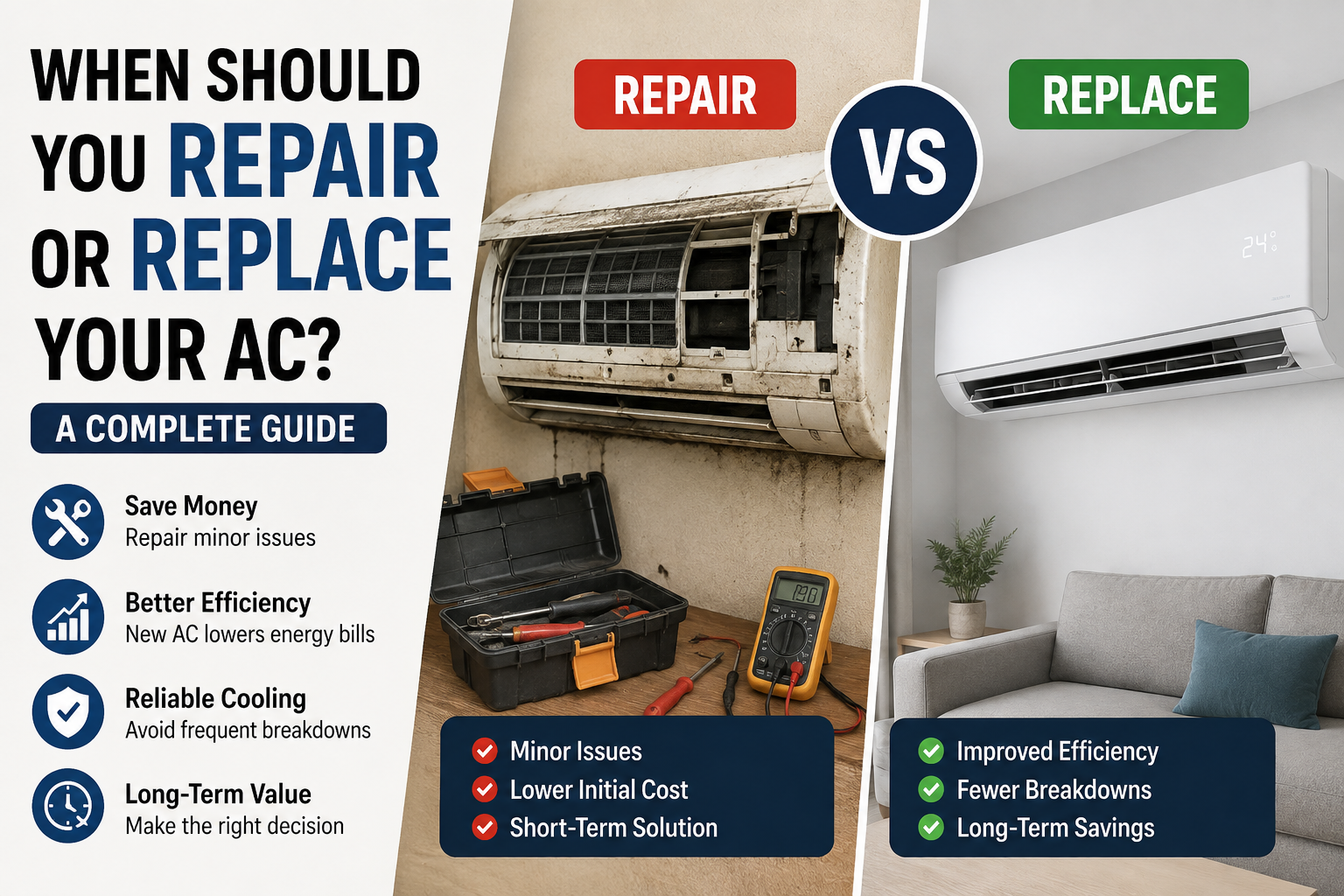
When Should You Repair or Replace Your AC? A Complete Guide
An air conditioner is an important investment for your home. When it starts causing problems, one of the biggest questions homeowners face is whether they should repair the existing AC or replace it with a new one.
Sometimes a simple repair can restore your AC and keep it working efficiently for years. In other situations, frequent breakdowns, high electricity consumption, expensive repairs, and an aging system may make replacement a better long-term decision.
This guide explains the key factors you should consider before deciding whether to repair or replace your air conditioner.
How Do You Know If Your AC Needs Repair?
Not every AC problem means you need a new air conditioner.
If your AC is relatively new and the problem is limited to a particular component, repairing it is often the more practical option.
Common AC problems that may be repairable include:
- Dirty air filters
- Blocked drain pipes
- Water leakage
- Faulty capacitors
- Electrical connection problems
- Fan motor problems
- Thermostat issues
- Drainage problems
- Airflow problems
- Sensor-related faults
A professional inspection can help identify whether the problem is minor or a sign of a larger system issue.
1. Consider the Age of Your AC
The age of your air conditioner is one of the most important factors when deciding between repair and replacement.
A relatively new AC that has been properly maintained may be worth repairing.
However, an older system with frequent problems may require increasing amounts of maintenance and repair.
Older AC systems may experience:
- Reduced cooling efficiency
- More frequent breakdowns
- Aging electrical components
- Higher electricity consumption
- Difficulty finding replacement parts
- Increasing maintenance costs
If your AC is becoming unreliable because of its age, replacement may be worth considering.
2. How Often Does Your AC Break Down?
One repair does not necessarily mean that your AC needs to be replaced.
However, frequent breakdowns can indicate that the system is reaching the end of its useful life.
For example, you may experience:
- Cooling problems
- Water leakage
- Fan problems
- Electrical faults
- Refrigerant issues
- Unusual noises
If different problems continue appearing one after another, the total repair cost can become significant.
In this situation, compare the cost of continued repairs with the cost of installing a new AC.
3. Compare Repair Cost With Replacement Cost
Before approving an expensive repair, consider the total cost of the repair and compare it with the cost of a replacement system.
If the repair is affordable and your AC is otherwise in good condition, repair may be the better option.
If a major component has failed and the repair is very expensive, replacement may provide better long-term value.
Consider:
- AC age
- Repair cost
- Previous repair expenses
- Energy efficiency
- Cooling performance
- Expected future maintenance
The cheapest option today is not always the cheapest option over several years.
4. Is Your Electricity Bill Increasing?
An increase in electricity consumption can sometimes indicate that your AC is no longer operating efficiently.
Possible causes include:
- Dirty filters
- Dirty coils
- Low refrigerant
- Poor airflow
- Aging components
- Compressor problems
- Lack of maintenance
Some efficiency problems can be solved through proper AC servicing and repair.
However, if an older AC continues consuming excessive electricity despite regular maintenance, replacing it with a more efficient system may be worth considering.
5. Your AC Is Not Cooling Properly
Weak cooling does not automatically mean that you need a new AC.
Poor cooling can be caused by several problems, including:
- Dirty air filters
- Dirty indoor coils
- Dirty outdoor condenser
- Blocked airflow
- Low refrigerant
- Faulty components
- Poor drainage
A technician should diagnose the problem before you decide to replace the entire system.
If the AC is old and continues to provide poor cooling even after proper repairs and maintenance, replacement may become the more practical option.
6. Frequent Refrigerant Problems
If your AC repeatedly develops low refrigerant, there may be a refrigerant leak.
Simply adding refrigerant may provide temporary cooling, but it does not solve the underlying problem if a leak is present.
A qualified technician should inspect the system and identify the cause.
If an older AC requires repeated refrigerant-related repairs, compare the ongoing repair costs with the cost of replacement.
7. Major Compressor Problems
The compressor is one of the most important components of an air conditioning system.
A compressor failure can be expensive to repair, especially when the AC is already old.
Before replacing the complete system, a professional technician should diagnose the compressor and evaluate the overall condition of the AC.
If the system is old, inefficient, and experiencing multiple other problems, replacement may make more sense than investing heavily in a major compressor repair.
8. Your AC Needs Major Repairs Every Year
Regular maintenance is normal, but repeated major repairs are a warning sign.
If you are spending significant amounts on your AC every year, calculate the total repair expenses and compare them with the cost of a replacement.
Ask yourself:
- How much have I spent on repairs recently?
- How old is the AC?
- Is the cooling performance still satisfactory?
- Has electricity consumption increased?
- Are new problems appearing frequently?
These questions can help you determine whether continued repairs are financially sensible.
9. When Should You Repair Your AC?
Repair is generally worth considering when:
- Your AC is relatively new
- The problem is minor
- Repair costs are reasonable
- Cooling performance is otherwise good
- The system has been maintained properly
- Major components are still in good condition
A professional diagnosis is recommended before approving any major repair.
10. When Should You Replace Your AC?
Replacement may be worth considering when:
- The AC is significantly old
- Breakdowns are becoming frequent
- Major components are failing
- Repair costs are becoming expensive
- Electricity consumption remains high
- Cooling remains poor despite repairs
- Replacement parts are difficult to find
- The overall system condition has deteriorated
Replacing an AC is a significant investment, so the decision should be based on the complete condition of the system.
Repair vs Replacement: Quick Guide
Repair Your AC If:
- The problem is minor
- The AC is relatively new
- Repair costs are manageable
- Cooling performance is good
- The system is generally reliable
- Major components are functioning properly
Consider Replacing Your AC If:
- The system is old
- Repairs are becoming frequent
- Major components have failed
- Energy consumption is consistently high
- Cooling remains poor after repairs
- Repair costs are becoming difficult to justify
- The AC has become unreliable
Don't Replace Your AC Without a Proper Diagnosis
One common mistake homeowners make is replacing an AC without first identifying the actual problem.
A dirty coil, faulty capacitor, blocked drain, airflow restriction, or electrical issue can sometimes make an otherwise healthy AC appear to be failing.
Professional inspection can help determine whether your AC needs:
- Cleaning
- Maintenance
- Minor repair
- Major repair
- Component replacement
- Complete AC replacement
Getting the correct diagnosis can help prevent unnecessary expenses.
How MendAI Can Help
If you are unsure whether your AC needs repair or replacement, MendAI can help you identify common AC problems and find the right service solution.
Instead of immediately replacing your air conditioner, getting the system properly inspected can help you understand the actual problem and make a more informed decision.
MendAI can help with common AC issues such as:
- Poor cooling
- Water leakage
- Unusual noises
- AC not turning on
- Airflow problems
- Refrigerant-related issues
- Frequent AC shutdowns
- General AC maintenance
Final Thoughts
The decision to repair or replace your AC depends on several factors, including its age, repair history, energy consumption, cooling performance, and overall condition.
A minor problem with a well-maintained AC may only require a simple repair. On the other hand, an older system with frequent breakdowns and expensive repairs may be approaching the point where replacement makes more sense.
Before spending money on a major repair or buying a new AC, get the system properly inspected.
Making the decision based on the complete condition of your air conditioner can help you avoid unnecessary expenses and choose the most practical long-term solution.